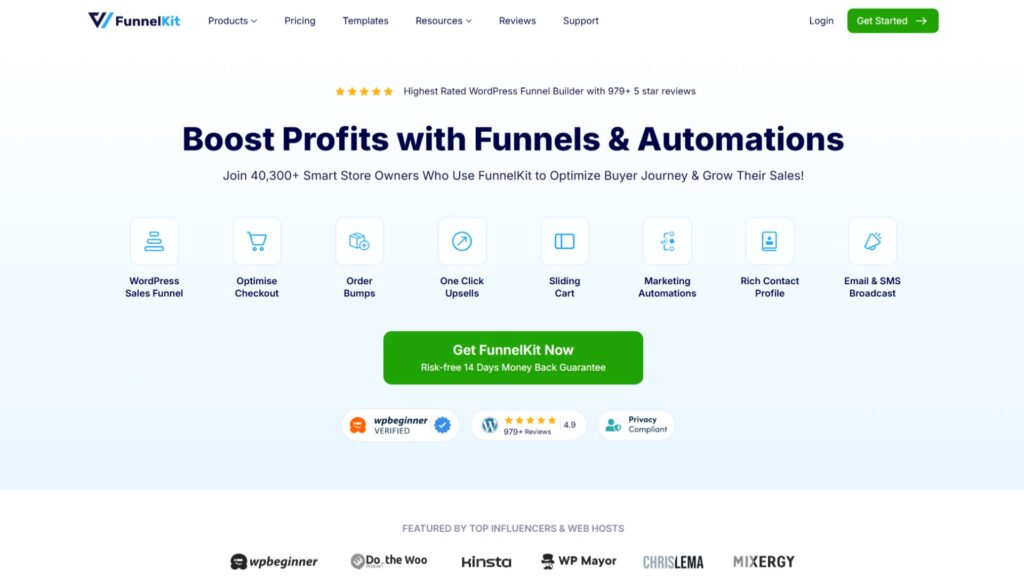

FunnelKit, formerly known as WooFunnels, is the most feature-complete funnel builder in the WordPress ecosystem. It combines checkout optimization, order bumps, one-click post-purchase upsells, a sliding cart drawer, and a built-in CRM in one product line. After testing it across digital and physical WooCommerce stores, I rate it 4.5 out of 5.
The average eCommerce cart abandonment rate sits at 70.19%, according to Baymard Institute. For WooCommerce stores running the default checkout, the multi-page layout and bloated field structure do not improve that number on their own.
I tested FunnelKit on a site and ran every major feature through proper testing across both digital and physical product setups. The checkout builder, order bumps, post-purchase upsells, email automations, and the cart drawer all received real use.
One thing deserves to be said upfront: the pricing structure is more complicated than it needs to be.
Here is what that 4.5 out of 5 is actually based on.
Key highlights
- FunnelKit rebranded from WooFunnels in October 2022 after Automattic asserted exclusive rights to the “Woo” trademark, unifying the product line under one brand name.
- Free versions of both the FunnelKit Funnel Builder and FunnelKit Automations are available on WordPress.org with limited functionality.
- A critical security vulnerability (CVE-2026-47100, CVSS 8.7) affecting over 40,000 WooCommerce stores was disclosed and patched within 36 hours in May 2026.
- In standardized WooCommerce hosting environment tests, FunnelKit checkout pages achieve a Largest Contentful Paint of 1.392 seconds versus CartFlows at 1.568 seconds.
- Post-purchase one-click upsells charge a tokenized card without the customer re-entering any payment details, available where the payment gateway supports tokenization.
- Razorpay integration supports UPI, local debit cards, and mobile wallets in India without redirecting customers to an external payment page.
- All paid plans carry a 14-day money-back guarantee; renewals are invoiced at full price.
What is FunnelKit, & What Happened to WooFunnels?
FunnelKit is a WooCommerce-native revenue optimization platform founded in 2018 as WooFunnels by Damanjeet Singh. In October 2022, the product rebranded after Automattic, the company behind WooCommerce, asserted exclusive trademark rights to the “Woo” prefix. The brand unified under FunnelKit, and Autonami, the standalone automation product, became FunnelKit Automations.
The Rebrand from WooFunnels to FunnelKit
The rebrand had nothing to do with the product itself. Automattic told the team that “Woo” was a protected trademark they reserved exclusively for their own use. Damanjeet Singh announced the change publicly, explained what happened clearly, and made it plain that the product, team, and support structure were not changing.
I read that announcement. The transparency stood out.
If you have been searching for a WooFunnels review, this is the same product.
What Does the FunnelKit Ecosystem Include?
FunnelKit consists of three separate plugins that work as one connected system: FunnelKit Funnel Builder for checkout and conversion pages, FunnelKit Automations for email marketing and CRM, and FunnelKit Cart for the sliding side drawer. They are sold as a bundled suite on paid plans. Installing all three gives you the full product; using only the Funnel Builder gives you checkout pages without the automation and cart layers.
FunnelKit Funnel Builder
FunnelKit Funnel Builder handles all customer-facing conversion pages: custom checkout layouts, pre-purchase order bumps, post-purchase upsell and downsell pages, opt-in pages, and thank-you pages. It integrates natively with Elementor, Bricks Builder, Gutenberg, Divi, and Oxygen, so pages are built inside whichever builder the site already uses, without touching PHP template files.
FunnelKit Automations
FunnelKit Automations replaces the need for a third-party email marketing platform inside WordPress. It includes a built-in CRM with 360-degree contact profiles, a visual workflow builder, broadcast campaigns, smart list segmentation, abandoned cart recovery sequences, and transactional email handling. All customer data and automation logs are stored directly in the WordPress database.
FunnelKit Cart
FunnelKit Cart replaces the default WooCommerce cart page with a sliding side drawer that activates before the customer reaches checkout. It supports real-time AJAX cart updates, progress bars toward free shipping thresholds or gift triggers, and in-cart product recommendations. This gives merchants a way to increase average order value before the customer even sees the checkout page.
What Does FunnelKit Do Well?
FunnelKit‘s strongest areas are the features that directly affect revenue: checkout friction reduction, pre- and post-purchase offer mechanics, and automated cart recovery. The team ships updates consistently. The product has moved forward every quarter across the years I have followed it, and that trajectory matters when choosing a tool you are building your store revenue on.
Checkout Optimization
FunnelKit’s checkout builder supports single-step and multi-step layouts, with a drag-and-drop field editor for rearranging, removing, or replacing form fields without code. Inline validation flags errors in real time before the customer submits. Smart login recognizes returning customers and pre-fills their billing details from prior orders.
For US-based stores, express payment buttons (Apple Pay, Google Pay, PayPal Express) integrate directly into the checkout page. Mobile customers can complete a purchase in seconds with those active, without typing out card numbers on a small screen.
For Indian stores, Razorpay handles UPI, local debit cards, and mobile wallets inside the checkout page itself, without sending the customer to an external payment screen. Keeping payment in-page reduces drop-off, especially on mobile, where every extra step costs conversions.
Order Bumps & Post-Purchase Upsells
Order bumps appear on the checkout page before the customer submits payment, adding a product with a single checkbox click. Post-purchase upsells appear after the primary transaction completes and charge the tokenized card without asking the customer to re-enter any payment details.
FunnelKit’s post-purchase upsell works because the payment gateway stores a tokenized version of the card during the initial transaction. One click, one charge, no second form. The customer never sees a payment screen again.
Both bumps and upsells run through a conditional rule engine, showing offers based on cart contents, order total, payment method, or customer purchase history.
One important note for Indian stores: Reserve Bank of India regulations require OTP authentication for most card and digital wallet transactions. This makes true one-click post-purchase charging difficult for Indian card transactions.
My read on it: this is a regulatory reality, and I hope it changes as Indian digital payment infrastructure continues to develop. Until it does, the practical workaround for Indian merchants is to focus CRO effort on pre-purchase order bumps instead. Since those are part of the primary checkout transaction, they process through the same OTP step and complete without friction.
Abandoned Cart Recovery
FunnelKit Automations captures email addresses the moment a customer types them into the checkout field, before they submit the form. If the customer leaves without completing the purchase, an automated recovery sequence fires automatically. Sequences support both email and SMS steps, with customizable delays and content based on the cart contents.
Built-in A/B Split Testing
FunnelKit includes native A/B testing for checkout layouts, order bump products, upsell offers, and offer pricing. Traffic splits automatically across variants, and the dashboard tracks view counts, conversion rates, and revenue per variant at each funnel step. No external testing tool is required.
How Does FunnelKit Perform Technically?
FunnelKit loads checkout scripts only on active funnel pages, keeping the rest of the store unaffected by the plugin’s presence. In standardized WooCommerce hosting environment tests, FunnelKit checkout pages achieve a Largest Contentful Paint of 1.392 seconds against CartFlows at 1.568 seconds, with a time-to-first-byte approximately 22% faster under equivalent conditions.
Core Web Vitals& Loading Speed
FunnelKit’s 1.392-second LCP sits well under Google’s 2.5-second mobile threshold, leaving a 1.1-second buffer before a checkout page enters the “needs improvement” range. For checkout specifically, where every extra millisecond increases the probability of abandonment, that buffer is not theoretical.
| Metric | FunnelKit | CartFlows | Google mobile threshold |
|---|---|---|---|
| Largest Contentful Paint | 1.392s | 1.568s | Under 2.5s (good) |
| Time to First Byte | ~22% faster | Baseline | Lower is better |
| Performance headroom (mobile) | 1.108s | 0.932s | Larger buffer = safer |
| Script loading scope | Active funnel pages only | Active funnel pages only | Minimal site-wide impact |
Database Considerations for High-Volume Stores
FunnelKit Automations stores CRM data, email logs, and contact interaction records directly in the WordPress database. For stores processing high order volumes, this creates a footprint that needs periodic management. A retention policy purging automation logs after 60 to 90 days keeps query performance clean during peak traffic periods.
What Does FunnelKit Cost?
FunnelKit runs on annual subscription plans only; no lifetime deal is available. The Basic plan starts at approximately $99.50 per year for one site. The Elite plan covers 30 sites at approximately $399.50 per year. Both the Funnel Builder and Automations plugins have free versions on WordPress.org for stores that want to test functionality before purchasing.
Pricing Tiers
| Plan | Approx. annual price | Sites | Key features included |
|---|---|---|---|
| Basic | ~$99.50 | 1 | Store checkout, thank-you page |
| Plus | ~$179 | 2 | Adds order bumps, upsells, sales funnels |
| Professional | ~$249 | 2 | Adds automations, CRM, broadcasts |
| Elite | ~$399.50 | 30 | Full feature set, multi-site |
Confirm current pricing at sync.win/funnelkit before purchasing. Promotional rates apply to initial purchases; renewals are invoiced at full price.
To be direct about something: I find this pricing model unnecessarily complicated. Every plan should include every feature, with the site limit as the only variable between tiers.
The current setup gates automations, CRM, and one-click upsells behind higher plans, which means customers on lower tiers never see the parts of the product that actually differentiate it from simpler alternatives.
Releasing someone onto a Basic plan and then asking them to upgrade to access the full tool is a frustrating experience. Simplify the tiers, vary by site count, and let every customer see the product properly from day one.
For agencies managing multiple client stores, the Elite tier works out to under $14 per site per year for the complete feature stack. That is genuinely competitive.
How Does FunnelKit Compare to CartFlows and WP Funnels?
FunnelKit is the most feature-complete of the three. CartFlows is a lighter checkout builder that depends on third-party tools for email and CRM. WPFunnels prioritizes a visual planning canvas and offers lifetime pricing options. FunnelKit is the only one with a native CRM, abandoned cart recovery, and the sliding cart drawer built into one product stack.
Side-By-Side Comparison
| Feature | FunnelKit | CartFlows | WPFunnels |
|---|---|---|---|
| Checkout builder | Yes | Yes | Yes |
| Order bumps | Yes | Yes | Yes |
| Post-purchase upsells | Yes | Yes | Yes |
| Native CRM and automations | Yes (built-in) | No (external only) | No (requires Mail Mint) |
| Sliding cart drawer | Yes (FunnelKit Cart) | No | No |
| Built-in A/B testing | Yes | Yes | Limited |
| Lifetime deal available | No | Yes (~$999 for 30 sites) | Available |
| Starting annual price | ~$99.50 (1 site) | ~$189 (10 sites) | ~$119.99 (1 site) |
I have used CartFlows on my past projects. It is good at what it does, and its modular approach keeps the local database lighter. If you already pay for ActiveCampaign or Klaviyo and want to keep them, CartFlows pairs well without overlap. FunnelKit makes more sense when you want everything inside WordPress on one license, without a separate subscription for email marketing.
A dedicated FunnelKit vs CartFlows comparison is coming to WPnomy. For a broader view of where these tools sit in the full landscape, the WordPress funnel plugins guide covers the wider field.
Page Builder Compatibility
FunnelKit Funnel Builder integrates natively with Elementor, Bricks Builder, Gutenberg, Divi, and Oxygen. Checkout pages, opt-in pages, and thank-you pages are all designed inside whichever builder the site already uses, with no custom template overrides or PHP edits required. This alone saves significant development time on client builds.
What About Security? the May 2026 Vulnerability
In May 2026, security researchers identified a critical vulnerability in FunnelKit’s public checkout endpoint. Tracked as CVE-2026-47100 with a CVSS 4.0 score of 8.7 (High), the flaw allowed unauthenticated attackers to overwrite plugin settings without authorization. Over 40,000 active WooCommerce stores were affected. FunnelKit released a patch within 36 hours.
What Happened & How The Team Handled It
The vulnerability existed because the checkout endpoint lacked proper authorization checks. Attackers used this to inject malicious JavaScript into the “External Scripts” setting, which merchants normally use for tracking codes like Google Tag Manager or Meta Pixel. The injected code ran a payment skimmer that captured card details in real time before transactions were submitted.
FunnelKit’s response, in order:
- Released Funnel Builder version 3.15.0.3 with capability checks, nonce verification, and a restricted allow-list of executable endpoint methods.
- Coordinated with the WordPress.org plugin review team to force-push the security update to all vulnerable sites.
- Reported attacker-controlled domains for DNS-level blocking.
- Released FunnelKit Automations version 3.8.1 concurrently, addressing SQL injection vectors and hardening automation rule-saving.
If you run FunnelKit on any site, confirm that Funnel Builder is on version 3.15.0.3 or higher and Automations is on version 3.8.1 or higher. Both are non-optional updates.
I have spoken with Daman on several occasions and have a good sense of how he runs this product. The 36-hour patch window on a CVSS 8.7 vulnerability, the forced update rollout, and the concurrent audit of Automations all reflect a team that takes its responsibility to users seriously.
Is FunnelKit Worth It? Verdict, Pros, & Cons
FunnelKit is worth buying for active WooCommerce stores that want to increase average order value and recover lost carts without stacking separate subscriptions for email marketing and CRM. The feature depth earns a 4.5 out of 5. The pricing complexity holds it back from a perfect score.
Pros & Cons
Pros:
- Deepest feature set of any WordPress funnel builder
- Native CRM and automations on Professional and Elite plans eliminate the need for a separate email platform
- Checkout LCP at 1.392 seconds, well under Google’s 2.5-second mobile threshold
- Built-in A/B testing and a conditional rule engine on higher plans
- Works natively with Elementor, Bricks Builder, Gutenberg, Divi, and Oxygen
- Razorpay integration covers UPI and local payment methods for Indian stores
- Active development team; Daman is responsive and visible in the community
- Free versions for both Funnel Builder and Automations on WordPress.org
Cons:
- Key features (automations, CRM, one-click upsells) are gated behind higher plan tiers
- WooCommerce-only; does not work with SureCart, FluentCart, or independently
- Local database storage for CRM data requires active management at scale
- No lifetime deal option
- Post-purchase one-click upsells face OTP friction on Indian card transactions
Final Scorecard
| Criterion | Score /10 | Note |
|---|---|---|
| Ease of use | 8/10 | Clean interface; first setup takes longer than expected |
| Feature depth | 10/10 | Most comprehensive in its class |
| Value for money | 7/10 | Strong product; confusing plan tier gating |
| Team and support | 9/10 | Responsive, transparent, and consistently improving |
| Checkout performance | 9/10 | LCP well under Google’s mobile threshold |
| Page builder compatibility | 9/10 | Works with every major WordPress builder |
| Overall | 4.5 / 5 |
Who Should Use FunnelKit, & Who Should Not?
FunnelKit fits active WooCommerce stores that want to grow revenue through order bumps, upsells, and automated cart recovery without paying for separate platforms. It does not fit stores considering a move away from WooCommerce, merchants on a tight budget who only need basic checkout fixes, or anyone who wants a lifetime license.
FunnelKit is the Right Fit When…
You run an active WooCommerce store, want order bumps, upsells, and email automation under one license, and can commit to at least the Professional plan. The lower tiers exclude automations, which is where FunnelKit separates itself from simpler checkout builders. The product does not show its full capability until you have all three plugins running together.
Use FunnelKit if:
- Your store runs on WooCommerce, and you want structured funnel mechanics (bumps, upsells, recovery)
- You want a native CRM and email automation without a separate subscription
- You manage multiple client stores and need one license covering up to 30 sites (Elite tier)
- You build in Elementor, Bricks Builder, Gutenberg, Divi, or Oxygen, and want full checkout design control
- Your store targets Indian customers and needs Razorpay, UPI, or local wallet payment support
Consider an Alternative When…
FunnelKit does not suit stores that are evaluating a move away from WooCommerce. If SureCart or FluentCart interests you as a lighter alternative, evaluate your platform choice before committing to FunnelKit’s WooCommerce dependency. A full breakdown of the two is at SureCart vs FluentCart.
CartFlows is a better fit if you already pay for an external email platform and only need checkout optimization at a lower upfront cost.
FAQs About FunnelKit
Does FunnelKit have a free version?
Yes. FunnelKit Funnel Builder and FunnelKit Automations both have free versions on WordPress.org. The free Funnel Builder covers basic checkout page creation. The free Automations handles simple email workflows. Features that drive meaningful revenue growth, including order bumps, one-click upsells, and full CRM, require a paid plan.
Is FunnelKit compatible with Bricks Builder?
Yes. FunnelKit Funnel Builder integrates natively with Bricks Builder, allowing checkout pages, opt-in pages, and thank-you pages to be designed inside Bricks without custom code. The integration is fully visual. Elementor, Gutenberg, Divi, and Oxygen are also fully supported.
Can FunnelKit work without WooCommerce?
No. FunnelKit is a WooCommerce extension and does not function independently. It is incompatible with SureCart, FluentCart, or Easy Digital Downloads. For stores evaluating their platform options, the WordPress eCommerce plugins cover where WooCommerce fits well and where alternatives make more sense.
What is FunnelKit’s refund policy?
All paid plans include a 14-day money-back guarantee on the initial purchase. Refunds are not issued after the 14-day window closes. Renewal invoices are charged at full price; the discounted initial rate does not carry forward to subsequent years.
How do Indian merchants handle the post-purchase upsell OTP limitation?
The Reserve Bank of India requires OTP authentication for most Indian card and digital wallet transactions, which prevents one-click post-purchase charging from completing on those payment methods. The practical solution is to focus conversion effort on pre-purchase order bumps placed on the checkout page. Since those are added to the cart before the primary transaction is authenticated, they process through the same OTP step and complete without any friction.
Conclusion
FunnelKit is the most complete funnel-building system in the WordPress ecosystem, and it earns that position through feature depth, consistent development, and a team that treats users well. Four and a half out of five is an honest score, not a generous one.
The pricing structure is my genuine frustration with the product. All features should be available on every plan, with the site count as the only tier variable. Feature gating makes an already capable product look more complicated than it is, and it pushes users toward upgrades before they have seen the full tool.
For WooCommerce stores ready to invest in the full stack, FunnelKit is the right call. If you are still working out which eCommerce platform fits your setup, the WordPress eCommerce plugins comparison is the right place to start before committing to anything.
FunnelKit covers all paid plans with a 14-day money-back guarantee, and free versions of both Funnel Builder and Automations are on WordPress.org to test before paying anything.
If you’re looking for an expert to set up the FunnelKit for your WooCommerce store, our dedicated WordPress support can help you with just that.
Running a WooCommerce store in Kolkata or India? FunnelKit’s Razorpay integration supports UPI natively, and we help Indian merchants configure and get the most from their WooCommerce setups: get support here.