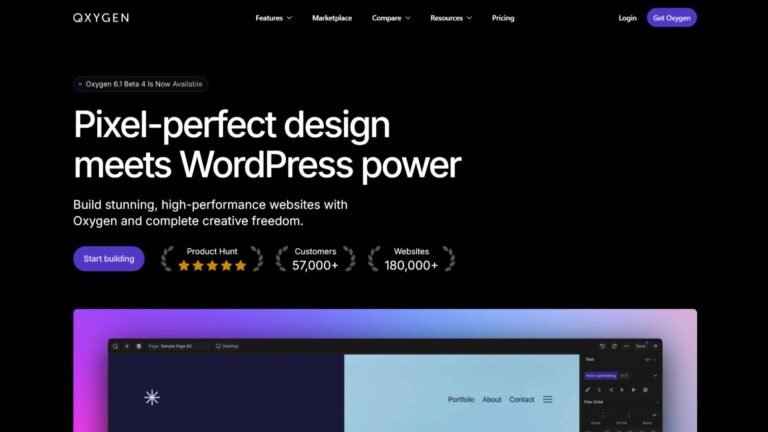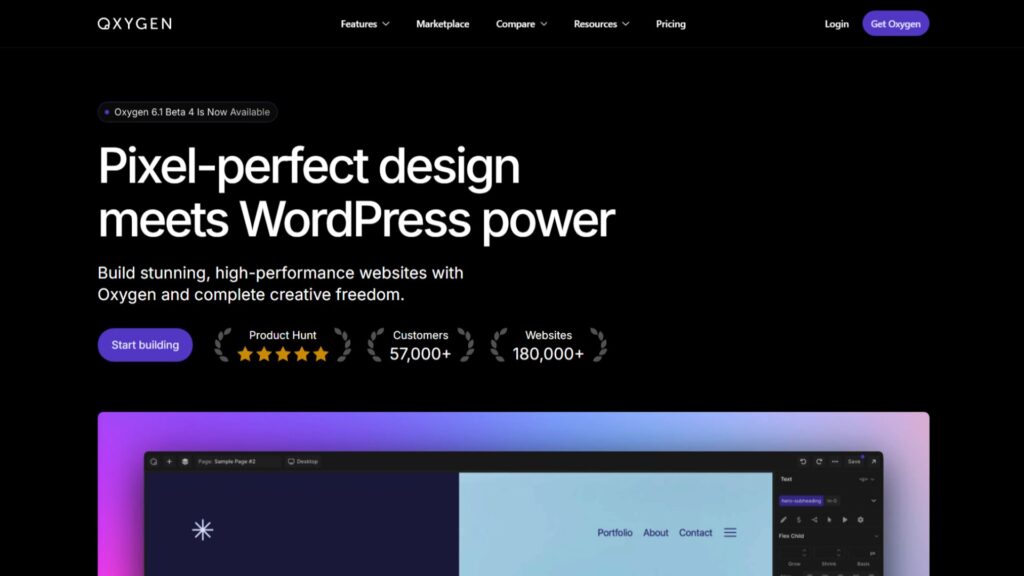

Oxygen Builder Version 6 is a complete rewrite of Oxygen Classic, rebuilt on a Twig/PHP/JavaScript core that shares 80% of its code with Breakdance. It produces clean, semantic HTML, lifetime pricing from $129 one-time, and an editor that feels significantly more logical than its predecessor. This review covers Oxygen 6 only. If you are researching Oxygen Classic, that product is effectively end-of-life and is reviewed separately.
Oxygen is the reason I started thinking about WordPress development differently. For years, it was my primary tool for anything performance-sensitive. The class-first approach it pushed me into became the foundation of how I build sites today, and that influence never really went away, even after I moved to Bricks.
When Soflyy announced Breakdance as a new competing product instead of rewriting Oxygen, it felt like a missed opportunity that still bothers me. They could have relaunched the rewrite as a new version of Oxygen, offered it to existing users for free, retired the old version after a migration window, and focused all their energy on one product. Instead, they now manage three products in the same category. The train has left the station on that decision.
Oxygen 6 is here now, and my honest reaction when testing the editor was excitement I did not expect. The UI feels fresh, logical, and genuinely different from anything Oxygen Classic ever was. For context on where this fits in the broader market alongside Bricks Builder, Elementor, and Builderius, the WordPress website builders guide covers all major options.
Key Highlights
- Oxygen 6 shares approximately 80% of its underlying code with Breakdance, built on a unified Twig/PHP/JavaScript core that replaces the legacy Angular framework from Oxygen Classic entirely.
- Lifetime licenses run from $129 (Basic) to $199.50 (Special Bundle), making it among the most cost-effective professional WordPress builders for agencies handling multiple client sites.
- Server-side optimizations include short-circuited Twig rendering for static templates, server-side active link detection to prevent CLS, and metadata caching that keeps TTFB fast without server upgrades.
- Version 6.1 introduced multi-element selection in the structure panel, native variable font support, and PHP 8.4 compatibility.
- Only 40.2% of WordPress websites globally pass all Core Web Vitals on mobile; Oxygen 6’s clean code output gives every build a strong structural baseline.
- A PHP fatal error on dynamic data used outside an active post loop is the most significant documented bug and can be a show-stopper for complex data-driven production projects.
- The ecosystem remains small: no public product roadmap, limited third-party add-ons, and basic elements require installing the bundled Breakdance sub-plugins.
What is Oxygen 6 & Who is it Built For?
Oxygen Builder Version 6 is a code-first visual WordPress builder rebuilt from the ground up on a Twig/PHP/JavaScript core, discarding the legacy Angular framework entirely. It replaces the active WordPress theme with its own rendering system and shares approximately 80% of its underlying code with Breakdance. Lifetime licenses start at $129 one-time for unlimited site installations.
How Oxygen 6 Differs from Oxygen Classic
Oxygen Classic ran on an Angular-based framework that became technically obsolete and was never rewritten during its active years. Oxygen 6 rebuilds the entire system on Twig, PHP, and shared Breakdance core code, producing a significantly more responsive editor, server-side performance optimizations, and a class-first styling methodology. Existing Oxygen Classic sites cannot be directly upgraded to Version 6: they must be rebuilt from scratch.
This is an important distinction for anyone maintaining legacy Oxygen Classic installations. There is no migration path. If you have clients on Oxygen Classic, you will need to plan full redesigns to bring them to v6. That is a real project consideration, not a minor inconvenience.
Who Should Choose Oxygen 6 in 2026?
Oxygen 6 is the right choice for Oxygen Classic users, Bricks Builder developers, and Builderius users who want a class-first visual environment with complete CSS control. For Elementor or Divi users transitioning to a performance-focused builder, Breakdance is the more appropriate starting point: it uses the same core engine but with a more accessible visual layer and 100+ pre-built elements ready to use.
This is the clearest positioning advice I can give on the two Soflyy products. Breakdance is for people coming from Elementor. Oxygen 6 is for advanced developers who already think in CSS classes and want full control over the markup. They share the engine. The audience is genuinely different.
Current pricing (one-time lifetime, unlimited sites):
| Package | Price | What it includes |
|---|---|---|
| Basic | $129 | Lifetime access, Gutenberg block builder, simplified client UI |
| WooCommerce | $149 | Basic features plus WooCommerce visual controls |
| Ultimate | $179 | All features, composite elements, and the Gutenberg block builder |
| Special Bundle | $199.50 (standard: $399.99) | Ultimate plus Breakdance Elements, WooCommerce, and Forms sub-plugins |
What does Oxygen 6 do well?
Oxygen 6’s core strengths are its fresh, logically structured editor, native CSS variables manager, Element Studio for custom element creation, and built-in interactions and animations. Server-side optimizations, including short-circuited Twig rendering, server-side active link detection, and metadata caching, produce fast TTFB and minimal CSS file sizes out of the box, without requiring heavy caching configurations.
Editor Interface & UX
The Oxygen 6 editor is a meaningful improvement over Oxygen Classic in both visual logic and responsiveness. The design feels fresh, coherent, and intentional. Controls are where you expect them. The overall interface is the kind of thing I think Builderius should study: structured, clean, and immediately easier to navigate than its predecessor.
That said, the overall UX improvement over Oxygen Classic is significant enough that it made me want to start using it again alongside Bricks.
CSS Variables, Element Studio, & Interactions
Oxygen 6 includes a native global CSS variables manager for defining design tokens (colors, typography, spacing, border radius) that cascade across the full site. Element Studio enables building custom elements using Twig templating, HTML, CSS, and JavaScript, with visual controls mapped directly to code output. Built-in interactions and animations handle scroll-triggered effects and hover states without requiring third-party animation plugins.
Element Studio is one of the features I genuinely appreciate about the direction Oxygen 6 is taking. The ability to build custom elements visually, with Twig and JavaScript behind them, is the kind of developer control that shortens build time on complex projects significantly. Other builders bolt this on as an add-on. Oxygen 6 built it into the core.
The CodeMirror 6-powered code editor adds Emmet shortcuts, autocomplete, and a visual indicator that distinguishes inherited from overridden CSS properties. For developers who work in code blocks alongside the visual editor, this level of code tooling is genuinely useful rather than cosmetic.
Reusable Components & The Code Workflow
Oxygen 6 includes reusable components for saving and deploying design patterns site-wide. How deep this system is compared to Bricks Builder’s component architecture is worth testing on your own project types before committing, since documentation on the specific capabilities is limited.
Custom code is managed through native code blocks for HTML, CSS, JavaScript, and PHP directly inside the builder. WPCodeBox is the officially recommended external tool for managing complex snippet workflows across multiple installations. This is not friction in the way it might sound: it is the same approach professional developers already use with tools like Advanced Scripts, Scripts Organizer, or FluentSnippets. WPCodeBox is best in class at what it does, and the combination works cleanly.
The server-side performance optimizations built into v6 deserve a clear summary:
| Optimization | Mechanism | Practical impact |
|---|---|---|
| Short-circuited Twig rendering | Bypasses token processing for static templates | Faster TTFB on pages with no dynamic content |
| Server-side active link detection | Computes menu states server-side before the browser renders | Prevents CLS; removes heavy JS from client side |
| Streamlined breakpoint CSS | Base-breakpoint utilities output once only | Keeps CSS files compact; prevents responsive bloat |
| Metadata caching | Caches structural metadata via the PHP pipeline | Reduces server resource use under load |
| Minified CSS generation | Writes minified cache only when styles actually change | Minimizes file sizes; accelerates repeat page loads |
| Instant save commits | Commits modifications to headers/footers immediately | Eliminates visual cache mismatch on multi-page edits |
Where Does Oxygen 6 Fall Short?
Oxygen 6’s documented technical bugs include PHP crashes on dynamic data outside active post loops, JavaScript loading failures on Nginx with PHP 8.3, sticky header CSS errors, and null query failures on search result templates. The ecosystem is small, no public roadmap exists, and integration with the broader WordPress third-party plugin market is limited compared to Bricks Builder or Breakdance.
Known Bugs & Production Risks
The most critical bug for production work is a PHP fatal error triggered when using dynamic data for custom fields outside an active post loop. This can crash the rendering pipeline on certain hosting setups and is a genuine show-stopper for complex data-driven projects until it is patched.
The other documented bugs in the current release:
- JavaScript loading failures on Nginx/PHP 8.3. Elements, including the Header Builder, can fail to load because the builder searches for script files in the wrong directory. The workaround is symlinking the subplugins assets folder to the main plugin’s assets directory: a server-level fix that requires hosting access.
- Admin menu duplication. A known backend bug causes administrative menu items to duplicate in the WordPress admin panel when the builder is active.
- Sticky header CSS error. Sticky headers occasionally output
position: relativeinstead ofposition: sticky, breaking scroll navigation on the front end. - Null query condition failures. Global template conditional visibility rules can fail on null queries, occasionally breaking search results page layouts.
- Font weight variable gap. No GUI control exists for declaring custom font weight variables; developers must enqueue them via external snippets manually.
From everything I know about the team, they will fix these bugs faster than they ever fixed Oxygen Classic issues. With Classic, there were years of unresolved bugs that the community simply accepted. Oxygen 6 is under more active development pressure. The PHP crash on dynamic data is the one I would test thoroughly before any live client deployment.
Ecosystem Gaps & the Missing Roadmap
Oxygen 6 has no public product roadmap. For agencies trying to plan project timelines around upcoming features, this creates real uncertainty. You are committing to a tool without knowing what the development priorities are.
The third-party add-on ecosystem is small. There is no equivalent to the Bricks add-on community or the Elementor add-on market. Basic design elements, including headings, buttons, and icons, are not in the core installation: you need the bundled Breakdance Elements for Oxygen sub-plugin to access them. This is a deliberate design choice to keep the core lean, but it requires an extra installation step that new users will not expect.
Integration with the broader WordPress plugin ecosystem is also limited compared to Bricks Builder and Breakdance. Forms, popups, and WooCommerce layouts route through Breakdance sub-plugins rather than native Oxygen 6 components or widely available third-party tools.
How Does Oxygen 6 Compare to Alternatives?
Oxygen 6 sits alongside Bricks Builder as the strongest code-first visual builder for advanced developers in 2026. Both produce minimal DOM output, eliminate jQuery, and require CSS knowledge. Oxygen 6 is slightly more accessible for developers transitioning from Oxygen Classic, while Bricks has a larger ecosystem, stronger community resources, and better third-party add-on support.
The detailed Bricks versus Elementor comparison is covered in the Elementor vs Bricks breakdown. For the Oxygen Classic versus Oxygen 6 context, the Elementor vs Oxygen comparison gives useful background on where Oxygen has historically positioned itself against the mainstream market.
Builder comparison:
| Metric | Oxygen 6 | Bricks | Breakdance | Elementor |
|---|---|---|---|---|
| Foundation | Twig/PHP/JS (80% shared with Breakdance) | Vue.js theme | Modern plugin | Legacy jQuery plugin |
| Target audience | Advanced devs / Oxygen Classic users | Developer-focused agencies | Agencies and marketers | Beginners and SMBs |
| DOM output | Extremely clean | ~75–100 elements | ~150–200 elements | 1,500+ elements |
| jQuery dependency | None | None | Minimal | Heavy |
| Built-in elements | Via Breakdance sub-plugin | Native comprehensive library | 100+ ready-to-use | 118+ (Pro) |
| WooCommerce | Via Breakdance sub-plugin | Full custom layouts | Native out of box | Pro templates |
| Ecosystem size | Small | Growing, strong add-ons | Growing | Very large |
| Pricing model | Lifetime from $129 | Lifetime from $599 or annual | Annual from $99.99 | Annual from $59 |
| Public roadmap | No | Yes | Limited | Yes |
LiveCanvas and Builderius are worth noting for developers who want HTML-native minimalism beyond what Oxygen 6 offers. The Builderius review covers the most technically advanced option for developers willing to wait for production readiness.
Is Oxygen 6 Worth it in 2026?
Oxygen 6 is worth it for advanced developers, Oxygen Classic veterans, and Bricks Builder users who want a second builder in their stack for the right project types. The lifetime pricing at $129 to $199.50 is among the best value propositions in professional WordPress development. The PHP crash bug on dynamic data is a real production risk that warrants careful testing before live deployment on complex data-driven sites.
I came away from testing Oxygen 6 wanting to use it again. That was not something I expected, given how I felt when Breakdance launched. The team made a mistake in how they managed the transition from Classic to v6. They have also since offered every Oxygen user a free v6 license and included all Breakdance add-ons. That was the right decision. It came later than it should have, but it was the right call.
I still feel something for Oxygen that goes beyond tool evaluation. It is the builder that changed my journey in the WordPress space. Oxygen 6 being genuinely good is something I am glad about on a level that is not entirely rational. And I would recommend it to anyone who wants a high-quality, developer-focused builder today.
Pros:
- Fresh, logically structured UI that is significantly better than Oxygen Classic in every way
- Native CSS variables manager, Element Studio, and built-in interactions and animations
- Server-side optimizations produce fast TTFB and minimal CSS files without configuration overhead
- Lifetime pricing from $129 one-time for unlimited sites is an excellent long-term value
- Free license offered to all Oxygen Classic holders, bundled with Breakdance add-ons
- Version 6.1 adds multi-element selection, variable font support, and PHP 8.4 compatibility
Cons:
- PHP crash on dynamic data outside active post loops is a production show-stopper until patched
- No public product roadmap makes planning future project commitments difficult
- Basic elements require installing the Breakdance sub-plugin; not included in core
- Ecosystem is small: limited third-party add-ons, templates, and community tutorials
- No direct upgrade path from Oxygen Classic: all existing sites must be rebuilt
- JavaScript loading failures on Nginx/PHP 8.3 require a server-level workaround
My rating: 4.2 / 5. A genuinely strong developer-focused builder with excellent lifetime pricing. The bugs need resolving before it is safe for complex production deployments, but the direction and the product quality are there.
FAQs About Oxygen Builder v6
These are the most common questions from developers evaluating Oxygen 6 in 2026, answered from direct editor testing, research into version 6.1, and several years of experience with Oxygen Classic before moving to Bricks. All answers cover Oxygen 6 specifically, not Oxygen Classic.
Can I upgrade my existing Oxygen Classic site to Oxygen 6?
No. There is no direct upgrade path from Oxygen Classic to Oxygen 6.
The two products run on entirely different codebases: Oxygen Classic used Angular, while Oxygen 6 runs on Twig, PHP, and shared Breakdance core code.
Existing Oxygen Classic sites must be fully rebuilt to move to v6. If you are on Oxygen Classic and evaluating your options, the Oxygen Classic review covers the EOL context and the migration decision in detail.
How is Oxygen 6 different from Breakdance if they share 80% of their code?
The shared codebase means both builders deliver similar technical performance on the front end. The difference is in audience and philosophy.
Breakdance adds 100+ ready-to-use pre-styled elements, native WooCommerce builders, and a more accessible visual interface aimed at agencies and marketers coming from Elementor.
Oxygen 6 strips this back to a code-first environment for developers who want complete control over HTML structure and CSS. Same engine, fundamentally different design philosophy.
See also the Breakdance review and the Breakdance add-ons guide for a comparison of what the element library looks like.
Is Oxygen 6 ready for production client work?
For most project types, yes, with caveats.
The most significant production risk is a PHP fatal error triggered when using dynamic data for custom fields outside an active post loop. If your project uses complex dynamic data architectures, test this specific scenario thoroughly before committing to a live deployment.
The other documented bugs (admin menu duplication, sticky header CSS, JavaScript failures on Nginx) are manageable or have documented workarounds but require awareness before launch.
Who should choose Oxygen 6 instead of Bricks Builder?
Oxygen 6 is the stronger choice for Oxygen Classic veterans who know the Oxygen paradigm and want to stay within the Soflyy ecosystem.
The lifetime pricing at $129 to $199.50 is also significantly lower than Bricks at $599 lifetime, which matters for independent developers or small agencies. Bricks has a larger ecosystem, more mature community resources, and better third-party add-on support.
For developers starting fresh with no Oxygen history, Bricks is still the more proven production-ready option in 2026.
Is the WPCodeBox dependency a problem for Oxygen 6 users?
No.
Oxygen 6 includes native code blocks for HTML, CSS, JavaScript, and PHP inside the builder.
WPCodeBox is the officially recommended external manager for teams handling complex snippet workflows across multiple installations, similar to how professional developers already use Advanced Scripts or FluentSnippets.
It is not a required purchase. For single-site projects or simpler code needs, the native code blocks handle most scenarios without an external tool.
Conclusion
Oxygen Builder Version 6 is one of the most welcome builder releases in the WordPress ecosystem in years. The fresh editor, the server-side performance architecture, Element Studio, and the generous free license offer to Oxygen Classic holders all point to a team that genuinely cares about the product and has learned from what went wrong before.
The PHP crash bug on dynamic data and the ecosystem gaps are real limitations that should factor into any production decision today. If those are resolved in upcoming releases, Oxygen 6 becomes one of the strongest arguments for the Soflyy ecosystem.
For current client work, Bricks Builder remains the more stable production choice. For agencies evaluating the performance-first middle ground, the Breakdance review is worth reading alongside this one. The full comparison of every major builder is at the WordPress website builders guide.
If you are evaluating Oxygen 6, migrating from Oxygen Classic, or need guidance on which builder fits your agency workflow, our WordPress support can assess your setup and give you a clear direction.
For agencies in India and Kolkata building on performance-first WordPress stacks, we offer end-to-end project setup, builder selection, and ongoing support. If Bricks is part of your workflow, our dedicated Bricks Builder support service covers full builds and client handoff configuration.