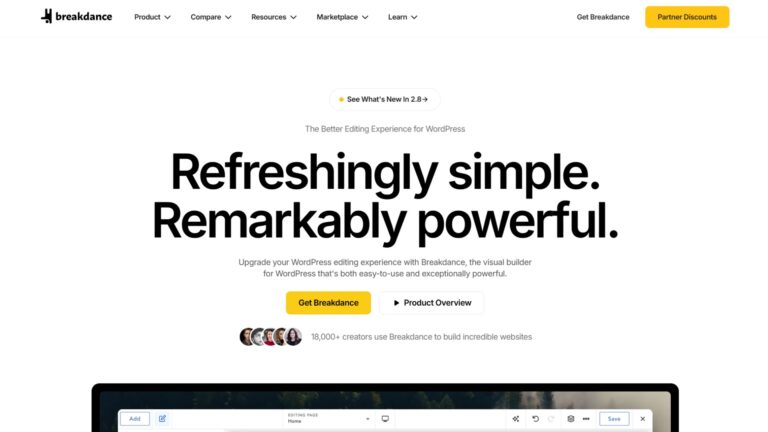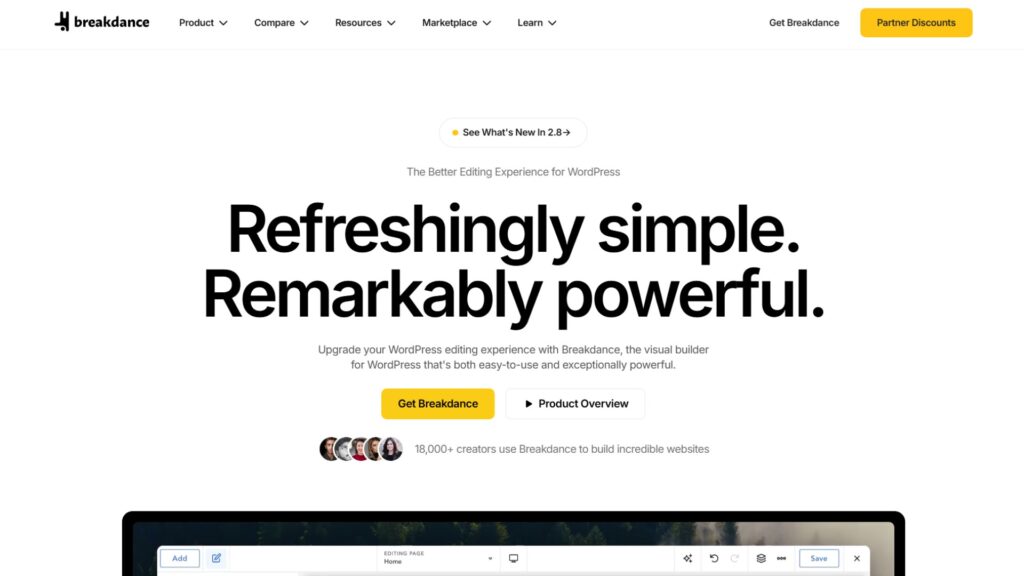

Breakdance is a performance-first WordPress page builder from the team behind Oxygen, delivering 85 to 95 PageSpeed scores and a 42 KB baseline asset size without additional configuration. It is easier to learn than Bricks Builder and significantly faster than Elementor straight out of the box. The Pro Unlimited plan costs $199.99/year with a price-lock guarantee against future renewal increases.
When I was looking for a better option after years on Elementor and then Oxygen, Breakdance was one of the first builders I evaluated seriously. The performance gap was hard to dismiss. A 42 KB baseline page weight versus Elementor’s 570 KB is not a marginal improvement. It is a different output category.
I tested it, came away impressed with what it does well, and then moved on to Bricks Builder for agency work. That choice reflected my specific build requirements and comfort level with class-first CSS, not a verdict against Breakdance as a product.
The performance-focused builder market in 2026 has four real contenders: Bricks, Breakdance, Builderius, and Oxygen 6. For a large portion of the WordPress professional market, Breakdance is the strongest choice among them. This review tells you exactly why, and for whom. If you want a broader look at the full landscape first, the WordPress website builders comparison covers all major options in one place.
Key Highlights
- Breakdance generates a 42 KB baseline page asset size versus Elementor’s 570 KB, a 93% reduction that directly affects mobile First Contentful Paint.
- Out of the box, Breakdance scores 85 to 95 on PageSpeed audits without caching or CDN setup; Elementor requires active optimization just to reach that baseline.
- DOM node depth averages 42 elements on a Breakdance build versus 1,500+ on Elementor, which is the primary architectural source of the performance gap.
- Only 40.2% of WordPress websites globally pass all Core Web Vitals on mobile, making a builder’s default output quality a real commercial differentiator.
- Breakdance 2.8 (mid-2026) added multi-element selection, variable font support, per-template form routing, and upgraded the slide engine to Swiper 12.
- Breakdance 2.7 cut the plugin package size by 50% and added WP-CLI support for server-side site management.
- The Pro Unlimited plan costs $199.99/year with a confirmed price-lock; over three years, the total cost of ownership ($599.97) is comparable to Elementor Expert ($597) while replacing $300 to $500/year in premium form, pop-up, and WooCommerce add-ons.
What is Breakdance & Who is it Built For?
Breakdance is a visual WordPress page builder built by the same team behind Oxygen Builder. The Pro version includes 145 design elements, a full WooCommerce styling engine, a built-in multi-step form builder, popup tools, and dynamic data loops from ACF and Meta Box. It eliminates jQuery from its core script stack, producing a baseline page asset size of 42 KB and an average DOM node depth of 42 elements per build.
The builder runs a four-panel workspace: an elements panel on the left, a structure (hierarchy) panel on the right, the visual editor in the center, and a pop-out code editor for custom CSS, JavaScript, and HTML. The layout keeps complex builds manageable without forcing developers through nested settings menus.
Tier breakdown:
| Tier | Price | What it includes |
|---|---|---|
| Breakdance Free | Free | 80 elements, basic forms and popups, unlimited sites |
| Breakdance Pro Unlimited | $199.99/yr (price-locked) | 145 elements, 37+ website templates, 1,000+ sections, WooCommerce, ACF/Meta Box, multi-step forms, CSS Class Manager, Custom PHP, Adobe Fonts |
The right audience for Breakdance is marketing agencies building service and e-commerce sites at volume, business owners who will manage the site after handoff, and developers who want strong default performance without committing to a strict class-first workflow.
If you need the lowest possible learning curve and the widest plugin ecosystem, Elementor is still the most accessible starting point. If you are comfortable with CSS classes and want maximum DOM control, Bricks or Oxygen 6 go further.
What Does Breakdance Do Well?
Breakdance’s core advantage is delivering near-performance-first output without the developer discipline that Bricks Builder requires. Out of the box, it scores 85 to 95 on PageSpeed audits with a 42 KB baseline page weight.
The built-in toolset replaces a significant slice of the premium plugin stack that other builders require. Multi-step form builder, exit-intent and scroll-triggered popups, WooCommerce custom cart and checkout styling, Adobe Fonts, and CSS Class Manager all come bundled with Pro.
When I evaluated it, the math was clear: the plugins Breakdance includes natively would cost $300 to $500/year as separate premium tools on an Elementor setup. For agencies billing flat project rates, that net cost difference matters more than the headline price.
WooCommerce handling is genuinely strong. Custom cart, checkout, shop, and product page builders with native global styling controls mean you are not fighting theme overrides or loading additional WooCommerce styling plugins on top of the builder. The query structure is handled natively, keeping checkout performance competitive even on mid-tier shared hosting.
The Breakdance 2.8 update improved the daily workflow considerably. Multi-element selection via Cmd/Ctrl+Click or Shift+Click enables bulk editing of shared properties, simultaneous dragging, group duplication, and container wrapping in one step. Before 2.8, doing any of that required selecting elements one at a time.
Where Does Breakdance Fall Short?
The ecosystem gap is real and worth stating clearly. Breakdance’s third-party add-on library, template marketplace depth, and YouTube tutorial coverage do not come close to Elementor’s decade-long head start. For developers who depend on a specific third-party add-on, or for clients who need to self-troubleshoot using community forums, that gap creates friction.
The AI content writer is a separate paid add-on, not bundled with Pro. At $199.99/year, including a base AI tier, it is a reasonable expectation in 2026. Elementor One bundles 25,000 monthly AI credits at $168/year. Breakdance charging extra for this is a clear product gap relative to the competition.
Three additional points worth knowing before you commit:
- The Oxygen controversy. When Breakdance launched, Oxygen Builder lifetime license holders felt their platform was being deprioritized. The Oxygen 6 release resolved much of this, but the early handling left a mark on community trust. If you are inheriting a team with strong Oxygen loyalty, factor that into the decision.
- Mobile CWV specifics are not benchmarked publicly. The 85 to 95 PageSpeed scores are documented, but Breakdance does not publish specific mobile Core Web Vitals pass rates per hosting tier. Verify per build and hosting environment. Shared hosting still impacts results regardless of builder choice.
How Does Breakdance Compare to Alternatives?
Breakdance sits consistently between Elementor and Bricks on every axis: ease of use, code quality, ecosystem depth, and default performance. It outperforms Elementor on output cleanliness without demanding the CSS class discipline that Bricks enforces. Bricks still edges it on raw DOM minimalism (28 nodes versus 42) and pure PageSpeed ceiling.
Oxygen 6 now shares Breakdance’s editor engine, making it the strongest option for developer-focused teams who want the same visual interface with a more code-centric customization layer underneath. For detailed head-to-head comparisons, the Elementor vs Bricks Builder breakdown, the Oxygen Builder review, and the Bricks Builder review all cover the specifics.
Technical benchmarks:
| Metric | Elementor | Breakdance | Bricks | Oxygen 6 |
|---|---|---|---|---|
| PageSpeed (out of box) | 70–85 | 85–95 | 95+ | 95+ |
| DOM node depth | 1,500+ | 42 elements | 28 elements | Minimalist |
| Baseline asset size | 570 KB | 42 KB | Extremely light | Highly optimized |
| jQuery dependency | Heavy | Minimal (async) | None (Vue.js) | None |
| Mobile CWV default | 25–35% pass | Highly competitive | 55–65% pass | Superior |
| Built-in forms | Separate Pro add-on | Included in Pro | Limited native | Limited native |
| Built-in popups | Separate Pro add-on | Included in Pro | Limited native | Limited native |
| WooCommerce builder | Template overrides | Native global styling | Clean query loops | Extended dynamic |
LiveCanvas and Builderius are worth noting for developer-focused minimalists who want even cleaner output, though both carry steeper learning curves and thinner ecosystems than Breakdance.
3-year total cost of ownership:
| Builder | Year 1 | Year 2 | Year 3 | 3-Year TCO |
|---|---|---|---|---|
| Breakdance Pro Unlimited | $199.99 | $199.99 | $199.99 | $599.97 |
| Elementor Expert | $199 | $199 | $199 | $597 |
| Bricks Agency (annual) | $249 | $249 | $249 | $747 |
| Bricks (Lifetime) | $599 | $0 | $0 | $599 |
| Oxygen Ultimate | $179 | $0 | $0 | $179 |
The TCO figures shift in Breakdance’s favor once plugin replacement is factored in. Premium form builders, pop-up tools, and WooCommerce styling plugins can add $300 to $500/year on an Elementor or Bricks setup. On a net basis, Breakdance’s $199.99/year is often lower than what competing setups cost with a complete plugin stack.
Is Breakdance Worth it in 2026?
Breakdance is worth it for marketing agencies, service businesses, and e-commerce operators who need strong default performance without managing a complex CSS workflow. The Pro Unlimited plan includes built-in forms, popups, and WooCommerce builders that replace multiple premium plugins. At its price point and net cost, it is the most well-rounded builder for that audience.
For pure developers already comfortable with class-first CSS, Bricks delivers marginally superior output and more granular HTML control. For non-technical users who need the widest plugin ecosystem and community resources, Elementor is the more accessible choice. Breakdance earns its position by winning on balance between those two ends.
Pros:
- 85 to 95 PageSpeed scores without optimization, competitive with fully optimized Elementor setups
- 42 KB baseline asset size, 93% lighter than Elementor’s default
- Forms, popups, and WooCommerce styling bundled in Pro, eliminating multiple premium add-ons
- Price-lock guarantee on renewals
- Clean four-panel interface keeps complex builds manageable without nesting menus
- Free tier available on unlimited sites with 80 core elements
Cons:
- The third-party ecosystem is thin compared to Elementor’s decade of add-on development
- AI content writer is a separate paid add-on, not bundled with Pro plans
- Mobile CWV pass rates are not publicly benchmarked per hosting tier
- Launch controversy around Oxygen lifetime holders still affects community perception
- Builderius and LiveCanvas outperform on DOM minimalism for developer-focused workflows
My rating: 4.0 / 5. The strongest middle-ground builder in 2026. The right call for agencies and service businesses that need clean output without the Bricks learning curve.
FAQs About Breakdance
These are the questions that come up most often from developers and business owners evaluating Breakdance in 2026, answered from direct evaluation and comparison against builders used in active client work.
Is Breakdance free to use?
Yes. The Breakdance free tier runs on unlimited websites with 80 core design elements, basic form components, and basic pop-up tools. It excludes the full 145-element Pro library, 37+ complete website templates, 1,000+ page sections, WooCommerce custom builders, CSS Class Manager, Custom PHP, Adobe Fonts, and multi-step form logic. Most commercial builds need Pro at $199.99/year to access the full feature set.
How does Breakdance perform compared to Elementor?
Breakdance consistently outperforms Elementor on every core technical metric. It generates a 42 KB baseline page asset size versus Elementor’s 570 KB and scores 85 to 95 on PageSpeed without configuration, versus Elementor’s 70 to 85 even after active optimization work. DOM node depth averages 42 elements versus 1,500 or more on Elementor. For businesses where mobile load time directly affects conversion rates, the gap is commercially significant.
Is Breakdance better than Bricks Builder?
Breakdance is easier to learn than Bricks and delivers competitive performance for most commercial builds. Bricks produces slightly cleaner output (28 DOM nodes versus 42) and consistently scores 95+ PageSpeed by default, but requires a strict class-first CSS workflow that takes real time to learn well.
For agencies that need strong performance without deep CSS expertise, Breakdance is the stronger starting point. For developers already comfortable with class-first systems, Bricks provides more long-term control.
What is the relationship between Breakdance and Oxygen Builder?
Both are built by the same team, Soflyy. Breakdance was designed as a more accessible visual alternative to Oxygen, which disables the active WordPress theme entirely and requires deeper technical knowledge. The 2026 release of Oxygen 6 brought its editor engine closer to Breakdance’s interface, largely resolving the community controversy from Breakdance’s initial launch. Today, they serve different audiences: Breakdance for visual-first agencies, Oxygen 6 for developer-centric shops. The Oxygen Builder review covers Oxygen 6 in detail.
Should I use Breakdance or Elementor for a new client site?
For a client site where mobile performance and Core Web Vitals matter, Breakdance is the stronger starting point. For a client who will manage the site themselves and relies on existing Elementor-based themes or community support, Elementor’s larger ecosystem and learning resources make it the more practical choice. Read the Elementor review alongside this one before deciding. The right answer depends more on who manages the site after launch than on the builder’s technical specs.
Conclusion
Breakdance built its position by solving a real problem: it delivers the performance output modern search demands without requiring developers to master a class-first workflow or sacrifice visual flexibility. That is a genuine gap in the market, and it fills it well.
If you are building service websites, e-commerce stores, or agency client sites in 2026 and are not yet ready to commit to Bricks, Breakdance is the strongest builder in that middle tier. For more context, the full WordPress website builders comparison puts it alongside every major option, and the Bricks Builder review is worth reading if you want to understand what the step up looks like.
If you are building a new WordPress site, migrating from Elementor, or need expert guidance on builder selection, speed optimization, and full setup, our WordPress support handles it end-to-end, including dedicated Bricks Builder support for complex builds and migrations.